

“Whatever may be the ideological or idealistic characteristics of cultural expression, culture is an essential element of the history of a people. Culture is, perhaps, the product of this history just as the flower is the product of a plant.”
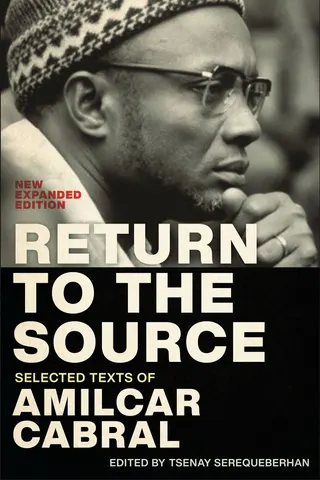
Quotes by Amílcar Cabral, each taken word for word from their books in the Ominira library.
“Whatever may be the ideological or idealistic characteristics of cultural expression, culture is an essential element of the history of a people. Culture is, perhaps, the product of this history just as the flower is the product of a plant.”
“Always bear in mind that the people are not fighting for ideas, for the things in anyone’s head.”
“We should avoid the superiority complex of those who know something and the inferiority complex of those who don’t know.”
“we in Guinea and Cape Verde, PAIGC, don’t struggle against Salazarism or fascism in Portugal. That’s the work of the Portuguese, not ours.”
“We do not struggle against the Portuguese or the Portuguese people; we struggle against Portuguese colonialism, against the Portuguese colonialists.”
“We have to remove the excessive burden on our people and we have to show them that we will never—not once—do them harm.”
“This is because a person who is capable of teaching shouldn’t distance themselves from anyone, especially from our people now. On the contrary, one should constantly immerse himself more among our people.”
“Mingle with and muddle around with yourselves, but don’t forget that it’s necessary to help rise up more each day.”
“The time is past when, in an effort to perpetuate the domination of peoples, culture was considered an attribute of privileged peoples or nations, and when, out of either ignorance or malice, culture was confused with technical power, if not with skin color or the shape of one’s eyes.”
“In our opinion, the foundation for national liberation rests in the inalienable right of every people to have their own history, whatever formulations may be adopted at the level of international law.”
“On the basis of what has just been said, we may consider the national liberation movement as the organized political expression of the culture of the people who are undertaking the struggle.”
“Whatever may be the ideological or idealistic characteristics of cultural expression, culture is an essential element of the history of a people. Culture is, perhaps, the product of this history just as the flower is the product of a plant.”
“Whatever may be the conditions of a people’s subjection to foreign domination, and whatever may be the influence of economic, political, and social factors in practicing this domination, it is generally within the culture that we find the seed of opposition, which leads to the structuring and development of the liberation movement.”
“Thus, it may be seen that, if imperialist domination has the vital need to practice cultural oppression, national liberation is necessarily an act of culture.”
“Repressed, persecuted, humiliated, betrayed by certain social groups that have compromised with the foreign power, culture takes refuge in the villages, in the forests, and in the spirit of the victims of domination. Culture survives all these challenges and, through the struggle for liberation, blossoms forth again.”